When most people hear the word “core”, they think of six-pack abs or crunches.
But your core isn’t just the front of your body.
It wraps all the way around your trunk: front, sides, and the back. And one of the most overlooked (yet critical) pieces of that system is lateral stability: your ability to control side-to-side movement.
If that system system is weak, your spine and pelvis don’t get the support they need during everyday life. This is where irritation, compensation, and recurring pain often show up.

Why Side-to-Side Stability Is Overlooked
Most traditional core training emphasizes:
- Flexion (sit-ups, crunches)
- Extension (back extensions)
- Sometimes rotation
What often gets missed is resisting motion side-to-side.
But think about how you actually move:
- Walking
- Standing on one leg
- Carrying groceries
- Hiking on uneven ground
- Rolling over in bed
- Squatting or lunging
All of these demand lateral control.
When the lateral hip muscles (especially the glute medius), inner thigh muscles, and side trunk muscles can’t do their job, your body finds another solution. Usually by dumping extra work into the low back.
Over time, that compensation can lead to pain, stiffness, or repeated flare-ups.
The Tent Analogy
Here’s an overly simplified, but useful, way to think about lateral stability.
Imagine your body like a tent:
The center pole = your spine
The side cables = your lateral stabilizers
If the side cables are loose, the whole tent wobbles. Even if the center pole is strong.
You can have strong abs and still lack the side-to-side support your spine needs. Without tension from the “side cables,” the structure becomes unstable under load or fatigue.
Lateral stability helps protect the spine from excessive strain and awkward torque during daily movement.
The Muscles That Matter
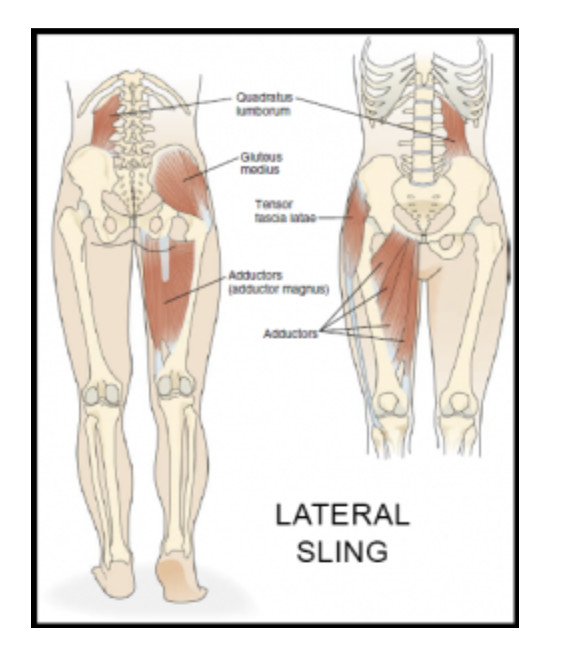
Lateral stability isn’t one muscle, it’s a group effort.
Muscles include:
Lateral hip muscles: Gluteus medius/minimus and upper glute max
Medial hip/thigh muscles: Adductors (inner thigh and groin)
Lateral trunk muscles: Obliques and quadratus lumborum
Together, these muscles help keep the pelvis level, the spine supported and movement efficient.
Exercise Spotlight: The Side Plank Cick here to watch!
The side plank is one of the simplest and most effective ways to train lateral stability.
Why it works:
Builds endurance and strength in the obliques, QL, and lateral glutes.
Improves pelvic and lumbar spine stability
Reinforces proper side-to-side control without excessive spinal motion
Frequency: 2-3 times/week or as tolerated
Reps and Sets:
Weeks 1-4: 3 sets at 5-7/10 perceived effort
Weeks 5-8: 4 sets at 7-8/10 perceived effort
Weeks 9-14: 4-5 sets at 8/10 perceived effort (10/10 means failure to hold an longer)
Key Cues:
- Keep your hips as high as possible without breaking form
- Press firmly through the downside foot
- Quality matters more than time
This isn’t about chasing the longest hold possible, it’s about maintaining clean, controlled alignment.
Exercise Spotlight: The Copenhagen Plank Click here to watch!
The Copenhagen plank takes lateral stability a step further by heavily challenging the inner thigh (adductor) muscles alongside the trunk.
Why it works:
- Improves strength and endurance in the groin and obliques
- Enhances pelvic stability
- Transfers well to walking, running, and athletic movement.
- Secondarily will strengthen your shoulders and neck
Frequency: 2-3 times/week or as tolerated
Reps and Sets:
Weeks 1-4: 3 sets at 5-7/10 perceived effort
Weeks 5-8: 4 sets at 7-8/10 perceived effort
Weeks 9-14: 4-5 sets at 8/10 perceived effort (10/10 means failure to hold any longer)
Important Note:
These can make you very sore if you’ve never performed them. Start conservatively and progress gradually.
A strong lateral core acts like a seatbelt for your spine, keeping everything aligned and supported when loads increase or fatigue sets in.
Why This Matters for Long-Term Spine Health
When your body can manage side-to-side forces:
- Your pelvis stays level
- Your spine doesn’t have to compensate
- Everyday movements become less irritating
- The risk of re-injury goes down
And once this system is built, maintenance requires far less time than constantly chasing pain relief.
Ready to Build a More Resilient Spine?
If you’ve been dealing with recurring back pain, stiffness, or instability - and feel like you’re always “one wrong move away” from a flare up - there may be a missing piece in your training or rehab.
Here at Iowa Spine and Performance, we help people:
- Identify weak links like lateral stability
- Build strength that actually transfers to real life
- Move with confidence again
Schedule a free discovery visit HERE and find out what your spine truly needs, not just for relief, but for long term resilience.

Dr. Cameron Whitehead
Contact Me